The course
Anatomy is learnt from specimens, not from an atlas.
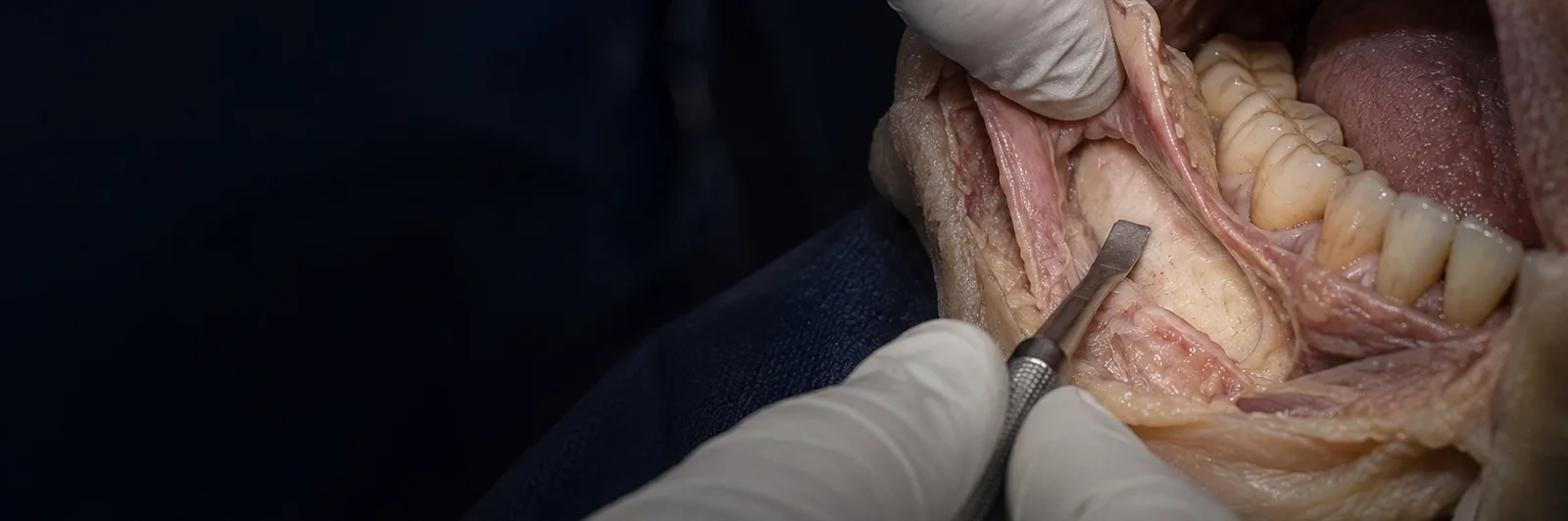
GATE is Level 3 of the course and is different from the others: it does not teach a technique, but rather teaches applied surgical anatomy through the dissection of fresh anatomical specimens.
It covers the structures of the oral cavity and adjacent regions, the risks of injury, and the principles of the procedures that will be carried out at subsequent levels: implant placement, split crest, sinus lift, and the use of meshes.
Passing GATE grants the prerequisite qualification for all cadaver-based courses in the programme — including the EXPERT specialities. This is why it sits in the middle of the progression rather than at the end.
What you will learn
The day alternates between theoretical sessions on surgical anatomy and guided dissection.
01
Theoretical programme
- Anatomy and physiology of the splanchnocranium
- Surgical anatomy of the maxilla: landmarks, structures at risk, maxillary sinus
- Surgical anatomy of the mandible: landmarks, mandibular canal
- Principles of anatomical dissection
- Principles of implant placement, split crest and sinus lift
- Introduction to advanced techniques on cadavers for the subsequent levels
02
Practical programme on fresh cadaver specimens
- Dissection of the maxilla: nasopalatine duct, foramen palatinum majus, buccal fat pad, maxillary sinus, foramen piriforme, infraorbital foramen and nerve
- Dissection of the mandible: mental foramen and nerve, lingual nerve, facial artery, muscles of the oral floor
- Implant placement, split crest and sinus lift on the specimen
- Surgical approaches for advanced techniques, with a concluding discussion
Why this course
Why this course
A gateway, not just any stage — GATE is the qualifying level: without passing it, the EXPERT specialism courses on cadavers remain off-limits.
Hands-on with fresh specimens — Dissection on fresh anatomical specimens is the only way to see the anatomical planes and relationships as they appear in the operating theatre.
Risks before techniques — Landmarks, high-risk structures and access routes are studied here, before an advanced technique puts them to the test on a patient.
Course procedures, practised on cadavers — Implant placement, split crest and sinus lift procedures are performed on cadavers: once a procedure has been practised, it is carried over to the next levels.
Intended audience
Who is it for?
Intended audience
Who is it for?
- 01Dentists holding the Basic Course certificate
- 02Dentists holding the All-on-4/6 Advanced Course certificate
- 03Those wishing to progress to the EXPERT specialism modules of the programme, which are conducted on cadavers
Requisiti
Entry requirement: both Level 1 and Level 2 certificates.
Details at a glance
Details at a glance
- Level
- 3 · GATE
- Format
- Theory and dissection on fresh anatomical specimens
- Venue
- ICLO Teaching and Research Centre, San Marino
- Dates
- 6 November 2026
- Credits
- 18 ECM per day
- Speakers
- Dr Andrea Guida, PhD (academic coordinator) · Dr Marco De Feo · Prof. Antonio Scarano
- Assessment
- Practical assessment during the dissection and final interview
- Certificate
- GATE preparatory qualification for courses involving cadavers
Assessment and Qualification
Assessment and Qualification
Assessment takes place during the dissection, focusing on practical skills, and is followed by a final interview.
Successful completion leads to the award of the GATE preparatory qualification: this document grants access to the programme’s cadaver-based courses, currently the EXPERT 4A and 4B specialisms, as well as future editions to be held using anatomical specimens.
Lecturers